
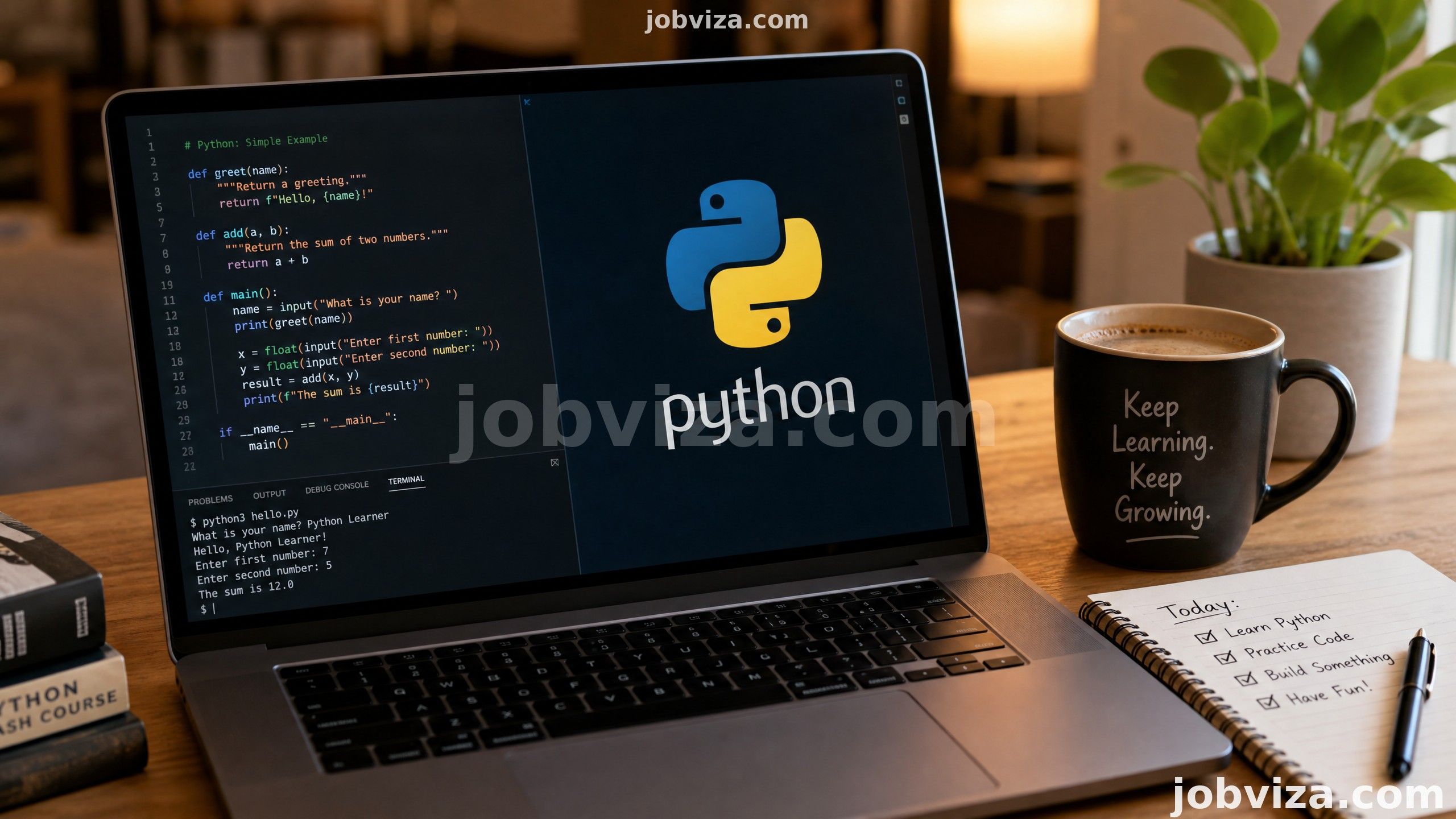
Updated 15 August 2026: Python can be a useful first programming language, but it is not automatically the best choice for every goal. Language choice depends on what you want to build, your environment, and the tools a project requires. Learning Python does not guarantee a job, freelance client, or income.
Start with official foundations
Python’s official getting-started page directs learners to documentation, tutorials, editors, examples, and the standard library. The official tutorial introduces the interpreter, basic syntax, control flow, functions, data structures, modules, errors, classes, environments, and packages. It is most suitable for learners who already have some basic programming understanding; complete beginners may need to move more slowly and practise each concept.
Learn by building small, honest projects
- Install Python from an official source and learn to run a simple script.
- Practise variables, conditions, loops, functions, lists, dictionaries, files, and errors.
- Build a small project that solves a clear problem, then document what it does and what you learned.
- Read the official documentation when you use a library or feature; do not paste code you cannot explain.
- Keep sample work clearly labelled and do not claim copied or generated code as experience you have not gained.
Use code responsibly
Do not run code from an unknown source on your device, paste secrets into a public repository, or use learning projects to access systems or data without permission. Protect API keys, passwords, and personal data. When working with a client, agree the scope, ownership, testing environment, and payment arrangement in writing.
Official Python resources
Discover more from Jobviza - Latest Jobs, Recruitment & Scholarships in Nigeria
Subscribe to get the latest posts sent to your email.