
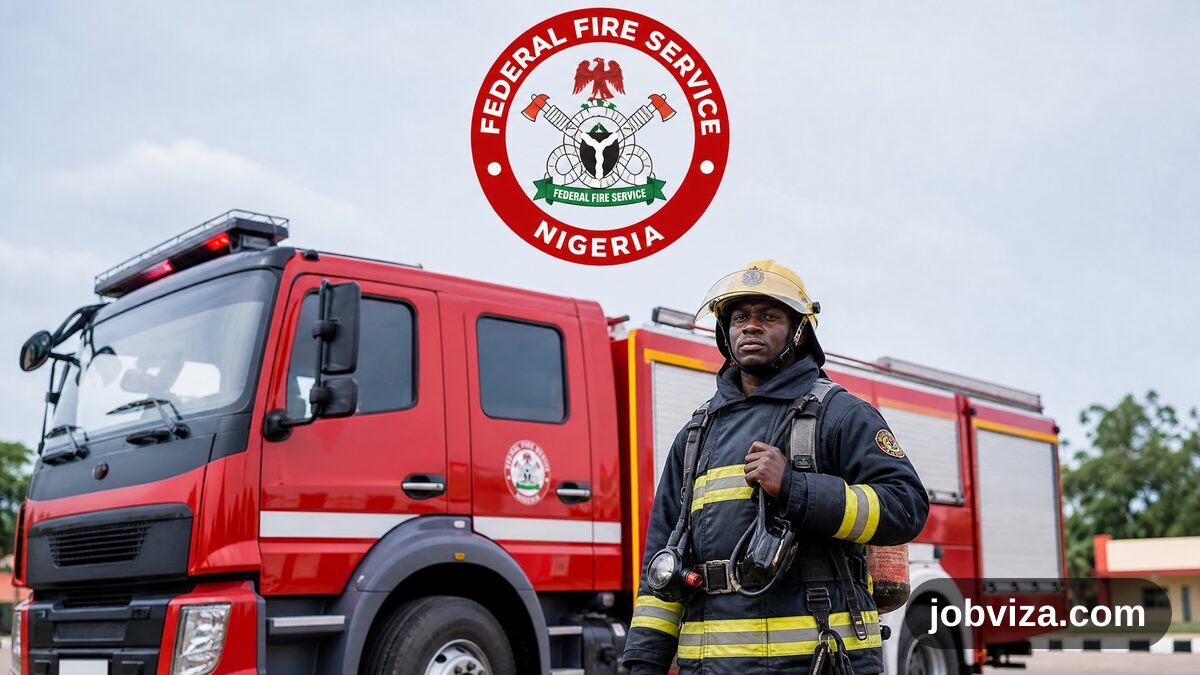
The Federal Fire Service is one of the paramilitary bodies many young Nigerians hope to join, and recruitment into it is handled centrally by the CDCFIB, the Civil Defence, Correctional, Fire and Immigration Services Board. There is no separate “fire service form”: you apply through CDCFIB and select the Fire Service as your agency of choice.
New intakes come in cycles, so do not assume applications are live until the board publishes an official notice. When a window opens, apply only through the official portal, recruitment.cdcfib.gov.ng. Any website that is not a gov.ng address is fake, and the genuine application is completely free. If anyone asks you to pay to apply, that is a scam.
Who can apply
Requirements vary slightly by cadre, but in general you need to be a Nigerian citizen by birth with a valid NIN and no criminal record. You will need your SSCE or NECO results (higher qualifications for senior cadres), plus supporting documents such as a birth certificate or age declaration and a certificate of state of origin. You also have to meet the age, height and physical-fitness requirements the board sets.
How to apply safely
- Visit the official CDCFIB portal and create an account with your NIN and a working email.
- Select the Federal Fire Service and choose the cadre that matches your qualification.
- Fill the form carefully, upload clear documents, then submit and print your application slip and Application Number.
- Check the portal yourself for shortlist and screening updates rather than relying on WhatsApp rumours.
Make sure the name on your NIN matches your certificates exactly, since mismatches are a common reason for rejection. Only candidates on the official shortlist are invited for screening, so a complete, accurate application really matters.
How the screening stage works
If your application is complete and you make the shortlist, CDCFIB invites you for a physical screening. For a paramilitary body like the Fire Service, that usually means verification of your original documents, a check of your height and physical measurements, and a fitness or medical assessment. Some cycles add a written aptitude test, so it is wise to revise basic English, mathematics and current affairs in advance. Keep yourself reasonably fit, since physical readiness genuinely counts here, and bring the originals of every document you uploaded. Only candidates on the official shortlist are screened, so a clean, accurate application is what gets you to this stage in the first place.
Documents to get ready
Prepare these before any window opens so you are not caught out: your NIN slip, SSCE or NECO result (and higher certificates for senior cadres), birth certificate or declaration of age, certificate of state of origin, a recent passport photograph, and a valid means of identification. Make sure the name and date of birth are identical across all of them, because a mismatch between your NIN and your certificates is one of the most common reasons applications are thrown out at verification.
Frequently asked questions
Does the Fire Service recruit directly? No. Recruitment runs through CDCFIB, which also handles Civil Defence, Correctional Service and Immigration.
Is the application free? Yes. Ignore anyone demanding an application fee.
Can SSCE holders apply? Yes. There are cadres for both SSCE holders and graduates.
How do I check my status? Log in to the CDCFIB portal with your NIN and Application Number.
If a message or “recruiter” asks for money, treat it as fraud, so learn the warning signs in our guide to recruitment scams in Nigeria. You can also compare requirements with the Nigeria Immigration Service recruitment, which runs through the same board.
What to check before you apply
Before you start any form, read the notice in full. The board’s notice names the agencies in that intake, the cadres open to you, the qualification each cadre needs, the age band and the closing date. Save a copy, because portal pages change and screenshots from older cycles can mislead you. If a notice mentions the Federal Fire Service but you cannot find the cadre you qualify for, do not guess. Check the official site or ask the board through its official contact details listed on the site.
Look at the details in your own documents too. Your date of birth on your NIN, your birth certificate or age declaration and your SSCE result should match. A difference in spelling, a missing middle name or a mismatched date can get an otherwise strong application rejected at verification.
What happens after you submit
After you submit, your application slip and Application Number are your reference for everything that follows. Keep both safe and do not share them with anyone who asks for them outside the official portal. Shortlist and screening updates are published on the portal, so check it yourself instead of waiting for a message to reach you. If you are not shortlisted for an intake, that does not mean you are barred from future cycles, so keep your documents in order.
Scam warning: fake Fire Service jobs
Fake Fire Service recruitment is common. Scammers copy the look of official notices, post fake portals on non-gov.ng addresses and ask for money for forms, shortlists, medicals or “guaranteed” slots. Some ask for your NIN, bank details or portal login. The genuine application is free. Never pay anyone to apply, never send your login to a third party, and never treat a call-up letter as real until you verify it through the official board.
Official links
The official recruitment board is CDCFIB. Its portal is recruitment.cdcfib.gov.ng, and its main site is cdcfib.gov.ng. Type these addresses yourself rather than using a link from a message or group chat.
Last updated: October 24, 2026
What the Federal Fire Service does
The Federal Fire Service is the national body responsible for fire prevention, fire fighting, rescue and fire safety across Nigeria. Its officers respond to fires and emergencies, inspect buildings for fire risk, advise property owners on safety standards, and take part in public enlightenment on fire prevention. Working in it means you are part of a uniformed service, which shapes daily life: discipline, shift work, training and a clear chain of command. Before you apply, be honest with yourself about that. It is physically demanding, and the work often happens at night, in bad weather and under pressure.
The service is a paramilitary agency, so it does not recruit people the way a private company does. Candidates usually come in through a central board, train together, and are posted where the service needs them. That also means your posting may not be in your home state, so think about whether you can live and work away from home before you commit.
Cadres and qualifications in general terms
Recruitment is organised by cadre, and each cadre has its own minimum qualification. In broad terms, some cadres are open to holders of the Senior School Certificate Examination (SSCE) or the NECO equivalent, while more senior or specialist cadres ask for a higher qualification such as a diploma, a degree or a professional certificate. Which cadre you fit depends on your exact result and subjects, so read each cadre’s stated requirement on the official notice and do not assume. If the notice is not clear to you, check the official site before you pick a cadre.
Requirements in general cover citizenship, a valid National Identity Number (NIN), a clean record and an age band. The exact age limits, height standard and physical measurements change between notices, so check the official site for the figures in the current intake. Do not rely on a figure you read in a forum or a WhatsApp group.
What the physical and medical stage looks like
Paramilitary recruitment usually has more stages than a desk job. In general, shortlisted candidates are called for document verification, then a physical screening that checks height, measurements and general fitness, then a medical assessment. Some intakes add a written aptitude test. The pattern is the same across most cycles, but the thresholds and the order of stages are set in each notice, so treat this as the outline rather than the rulebook.
Preparing for this stage is practical. Keep up regular exercise, especially running, push-ups and general stamina, since endurance tests are common. Get your eyes and general health checked early so you know about any problem before the medical. If a medical condition could disqualify you, it is better to find out now.
Frequently asked questions: more answers
Do I need work experience? Most entry-level cadres do not ask for prior work experience, but read the notice for your cadre to be sure.
Can a woman apply? Recruitment is open to qualified Nigerian citizens, subject to the same stated requirements, so check the official notice for the cadre you want.
What if I miss the window? Keep your documents current and check for the next official notice. Recruitment comes in cycles, so missing one window does not close the service to you for good.
Who should I trust for updates? Only the official CDCFIB portal and its verified channels. Anything else is a secondary source you should double-check before you act on it.
Related guides
- Federal Civil Service Recruitment 2026: How to Apply the Right Way
- FCSC Government Recruitment job 2026 Federal Civil Service Job Apply here
- Nigeria Immigration Service Recruitment 2026 Official Registration Portal
- Nigerian Correctional Service Recruitment: Official 2026 Status Guide
Reviewed by Miles Obi
Discover more from Jobviza
Subscribe to get the latest posts sent to your email.